Showing posts with label older students. Show all posts

Thursday, July 31, 2014

Cause & Effect Pictures! (plus TpT news!)

I am always trying to find creative ways to work on higher level skills without seeming like a reading teacher.  I recently created my Inferencing Pictures activity.  Since cause & effect is another skill my students struggle with and I'm often working on, I created a similar activity for this goal!
Using this activity:
-Print (and laminate) all picture cards provided.
-Show images to students.  Have them describe what they see.  Then have them read and answer the question provided.  42 cards included!
-Visual aid provided to assist in understanding how to infer.

-Graphic organizer is included to help generate responses as well.  


I recommend using this activity with older elementary and middle school students.  You can access this activity in my TpT store by clicking HERE!

If you haven't heard, TpT is holding a back to school sale!!  Time to stock up on supplies for the new year at a HUGE discount!!  I'm participating, so you can get up to 28% off!!!  Click HERE to view my entire store!

Sunday, July 27, 2014

Inferencing Pictures!

I have many students on my caseload working on inferencing.  I try to target this skill at all levels (pictures, sentences, paragraphs, and stories).  I often run out of materials to target inferencing at the picture level.  Well...I created a new activity to fix that!

Using this activity:
-Print (and laminate) all picture cards provided.

-Show images to students.  Have them describe what they see.  Then have them read and answer the question provided.  42 cards included!

-Visual aid provided to assist in understanding how to infer.


-Graphic organizer is included to help generate responses as well.  Spaces included for writing about 10 cards.
You can access this activity in my TpT store by clicking HERE!

Tuesday, July 22, 2014

Having A Reader's Notebook - Guest Blogger!

Today I share with you information from a literacy teacher/blogger/TpT seller.  As SLPs we are often collaborating with reading specialists since they typically see similar weaknesses and are working on similar skills.  Keep reading to learn more!!

I like to use many strategies and techniques in my reading classroom.  One such technique is a reader's notebook.  Having students complete a reader's notebook really allows students to interact with a book. It gives them the opportunity to reflect and record their feelings about what they are reading, as well as giving them the chance to analyze the story and how its written.  

I find this important because students often just rush through their reading assignments rather than really trying to understand the text.  My students are often reluctant to begin a reader's notebook but I often find it is something they eventually enjoy doing because it lets them be honest about their feelings without the fear of being judged by their peers. This benefits me by really being able to see what they understand and what they are struggling with.

I like to have my students glue the checklist in the front of their readers notebook.  It is important to me that my students use different prompts so I like the checklist because I can quickly monitor how often they are using a specific one. 

On Fridays I have my students complete an exit ticket response page that they turn in.  I respond to their writing and return the page on Monday.  This gives me the opportunity to monitor the responses and I get to respond to their entries on Monday they glue the response page into their notebook. Sometimes I have students work in pairs or triads on Monday to discuss the prompt they chose and their responses.  It is great watching their skills grow as they become more involved with the book and their discussions become more in depth.
How does this effect SLPs?!  Well, I often see students struggling with being able to:

  • discuss with their peers/myself
  • follow directions to complete this task
  • use a wide variety of feelings words
  • comprehend what they read in order to reflect
  • understand that others may have a different opinion
  • ability to write long responses/communicate in complete, complex sentences
  • understanding of common core vocabulary concepts
It is important for students to develop these skills so they can participate during ELA/literacy activities such as this above.  It is important for SLPs and ELA teachers/reading specialists to work together to achieve this goal and to build our students' reading comprehension abilities!

Beach Bum Literacy Chick is a reading specialist in an elementary school.  She uses up to date techniques and shares her hands on approach on her blog.  You can also find her on TpT, Pinterest, and Instagram!

Monday, July 21, 2014

The Curriculum Challenge (PART 2!!) --- freebie plus a giveaway!!

Did you catch my previous post regarding the "curriculum challenge?"  I have received amazing feedback from it!  I have also received several questions...so...I have answers and more!
What are some places you go to for curriculum materials/resources?

  • Ed Helper:  This website has great reading comprehension activities.  I have taken short stories and created speech/language activities with them.  Like what?  Pull out articulation words, make Venn diagrams to work on compare/contrast using facts from the text, and creating timelines to work on sequencing.
  • Reading A-Z:  This website has leveled books.  They have books related to curriculum content areas.  You can print out ones at your students' level.  It can be used for working on vocabulary.  It can also help you understand what vocabulary words students are expected to know related to that curriculum topic.
  • Teachers pay teachers!  Just search for the topics your students are working on!!  You will be surprised how many resources you can find!  I have found great sorting activities for vocabulary concepts, cause/effect activities, and other graphic organizers!
How is this different than what a resource room teacher or classroom teacher will do?
We have a different approach!  We work on skills first, then carryover.  For example, work on compare/contrast, make sure students understand how to and can express responses using complete sentences, then give them two science terms to compare/contrast.

We can break down the concepts and see where our students will struggle with our knowledge of their difficulties.  If your students can't answer wh- questions, they are going to struggle answering questions about a text read in their classrooms.  What can we do to help?  Make visual aids to help them recall the different wh- questions.  Pull out the text and show them how using their visuals can help them!

What kind of form do you use to keep teachers informed or to ask what they are working on?
I have created a newsletter template that can be easily completed to keep parents or teachers informed on what is going on in your therapy rooms.  It can be difficult to touch base in person with EVERY teacher you work with (especially if you are in multiple buildings).  You can find this newsletter resource in my TpT store by clicking HERE!

I also have a standard form I use to easily complete and place in teachers' mailboxes.
How do I use these?  I make several copies, cut them apart, and store in a file folder on my desk.  This way I have them ready to go!  All I have to do is complete for a student or place in a teacher's mailbox for them to complete regarding a student.  Although some teachers don't like extra paperwork, others have found that by completing these, I am able to help them and their students more and found it worthwhile!  You can access this freebie in my TpT store by clicking HERE!

I hope these posts have helped you with the curriculum challenge!  How about a giveaway of my speech newsletters?!  Enter to win below!!

a Rafflecopter giveaway

Wednesday, July 16, 2014

The Curriculum Challenge!

As an SLP in the schools, it is always a goal each year to incorporate the classroom curriculum into speech therapy sessions as much as possible.  Many speech and language students have curriculum vocabulary goals or comprehension skills goals that correlate to those skills necessary in the classroom environment.  As SLPs, our overall goal is to teach our students strategies in order to be successful academically and socially, and to eventually no longer require speech and language services.  But how can we incorporate the curriculum as much as possible into our speech sessions?

One way to battle this challenge is to use the classroom themes into speech sessions.  Are the classroom teachers using holiday, seasonal, or themes in their classrooms?  Design your lessons using storybooks and activities that use that same vocabulary.  It can be difficult to find common time to plan with all teachers on your caseload.  You can send monthly e-mails or make a form for teachers to complete with concepts and themes they plan on using that month or week.

Do you work with older students?  They may not be working on seasonal vocabulary but science and social studies concepts.  Again, you can send monthly or weekly e-mails or have a form for teachers to complete with what they plan on working on.  Another trick, walk around!  Many teachers hang student work in their classrooms and in the hallways.  Take a look to see what they are working on.  Another trick, ask your students!  You will be surprised how much they can share with you.  I like to ask them early in the week what they are working on and I will have activities ready to go the next time they come in with vocabulary concepts they told me about.  Use the internet to research vocabulary lists related to the topics they are working on if you do not have access to curriculum maps or textbooks.


Those are just some tips and ideas to help battle the curriculum challenge.  It is important for us, as SLPs in the schools, to incorporate the classroom curriculum into our therapy sessions as much as possible.  It helps make our therapy sessions relevant and promotes carryover of learned skills into the classrooms.  It also impresses and pleases our colleagues, which is always a bonus!

Monday, July 7, 2014

SLPs & Close Reading!

"Close Reading" have you heard that term?!  If your district/school is working to achieve the common core standards, then they might have trained the classroom teachers/reading specialists in this term.  I know in my district/building, this concept is HEAVILY promoted.  What does it mean and how does this effect SLPs??  ** DISCLAIMER: I AM NO EXPERT IN THIS!!  THIS IS JUST MY EXPERIENCE AND UNDERSTANDING AND HOW I USE IT!

According to Learning A-Z, "close reading" means that students get involved actively with texts they are reading.  They should notice text features and language used by the author.  They should be actively thinking while reading.  They are required to evaluate and think critically about the texts they are reading.

What skills are required in order for our students to be successful with close reading in their classrooms?

  • Asking and answering questions
  • Understanding of common core vocabulary concepts
  • Ability to infer and predict
  • Perspective thinking: understanding what others would think
  • Understanding text features
  • Understanding author's purpose
  • Understanding main idea and supporting details
  • Ability to retell or summarize a plot
  • and more!!
When teachers expect students to use this skill, they are expecting students to read passages about 3 times!  I know my students struggle to read things once!  It is important that students understand why they should use this skill and how it can benefit them.  Well, how can it benefit them and why is it important?!
  • Demonstrates understanding
  • Can help predict comprehension questions that one may be asked
  • Improves reading comprehension skills
  • Uses the full range of Bloom's taxonomy
  • Makes students active in the learning and reading process
How can we as SLPs help our students?!  We work on skills necessary in order for them to be successful in the classroom.  We can help improve these skills and then teach them how to use them during close reading tasks!  I have several products in my TpT store that can help build these skills.  Below are just SOME of them!:

I have also blogged about VARIOUS DIY ideas that can be used to work on these skills as well:

Remember, carryover carryover carryover!!  Once skills are learned and mastered, if students aren't shown how to use these skills independently in the classroom, then the jobs not done!!  We can model and practice with our students the art of close reading.  You can take passages read in their classrooms or use your own, high interest texts you can find.  You can elicit conversations with your students about the texts read.  What are some ways you can do this?!:

  • You can use conversations starters. Show them how to start conversations about the text.  For example, "I think the author wanted to tell us about..."
  • You can model how to use post-its to write questions about the text or to highlight the key points.  They can use their knowledge of main idea and supporting details for this one.
  • Discuss the characters, their character traits and how they felt in various parts of the story.
  • What connections can the students make to their own lives?
  • What were the key story elements (setting, characters, problem, solution, mood)?  Why were they important?  Did the author explicitly say it, why or why not?
  • Model for students to explain how they know what they know?  Can they locate the evidence in the story?
  • Be evidence detectives!! Who can find the most evidence to back up their opinions and analysis?!
Those are just several ways!!!  There are so many ways...how can you teach your students to think about their thinking about texts read?!


I know I hope to attend some workshops or view some online webinars on close reading this summer.  How do you plan on learning more?!

Tuesday, June 17, 2014

Cause & Effect Games!!

Many of you have been enjoying my Main Idea Games and my Context Clues Games activity packs.  Well...it is the time to introduce...my CAUSE & EFFECT GAMES!!  Yay!!!  I am always needing more cause/effect activities especially those for the paragraph level.  
Check out what it in this pack:
-Visual to assist

-Cause & Effect Matching Game:  Each card will have a sentence, either a cause or an effect.  Print, cut, and glue cards onto index cards, card stock or construction paper and laminate.  Students will use these cards in a memory matching game.  They must match the cause to the corresponding effect.  The student who matches the most is the winner!

-What’s The Cause? BINGO:  Print and laminate the BINGO cards for each student.  Then print and cut the passage cards.  Read to or have student read each passage card.  They must listen and locate the cause on their BINGO board.  Keep going until a student gets 5 in a row!

-What’s The Effect? Jeopardy:  Print and laminate the Jeopardy board.  Print and laminate the “candy cover tokens.”  Use the candy tokens or BINGO chips to cover up when a point value has been used.  Print and laminate the task cards.  You can keep them in piles by color to help locate them when students request them.  Students can take turns picking a “color” category and a point value.  Locate the corresponding task card.  Students must express the effect in order to receive the points.  You can keep track of points on a separate paper or board.  As students respond, students on both teams can complete the “note-taking sheet with the effect answer.”  Students can go back and forth picking and responding until all cards are used (or time runs out). 


-Review worksheets: One worksheet contains two paragraphs and students must identify the cause or effect from the choices provided.  The second worksheet require students to write the causes and effects on the lines provided based on the paragraphs read.
You can access this pack in my TpT store by clicking HERE!

Thursday, April 24, 2014

Shades of Meaning Puzzles!

Are you looking for more activities to build vocabulary and word knowledge??!  Do you have students working on synonyms but looking for a unique way to address this goal?!  This activity is for you!!  Build vocabulary and word knowledge with these fun puzzles!!

What is shades of meaning?  Some words can be similar in meaning like synonyms but these words have subtle changes in meaning.  They are closely related.  

Using this activity:
-Students must locate the different puzzle pieces that contain words with the same shades of meaning to put the 4-piece puzzles together.

-One puzzle piece will be “easy” with the word and an image.  The other 3 pieces will be “harder” words in sentences.  Students must use their context clues knowledge in order to determine which puzzles go together.

-To assemble:  Print all puzzles and cut them apart.  Laminate them.  Place all puzzle pieces in the middle of a pile/table.  Students can locate all of the puzzle pieces with images to start.  Then they can take turns picking puzzle pieces, reading the sentences, and using their context clues to determine which puzzle it belongs to.  Last, they can put the 4-piece puzzles together.
8 verbs and 8 adjectives are included!  The verbs have red stars and the adjectives have blue stars.  This way if you want to separate them and use one part of speech per session/lesson you can.  Can your students recognize that all of the words go together in the part of speech category?

-Verb & adjective visuals are provided.

-Review worksheets.


-Graphic organizer to document new vocabulary down.

You can access this activity in my TpT store by clicking HERE!

Tuesday, March 4, 2014

Introduction to Prefixes!

Are you looking for new ways to work on expanding vocabulary?!  Are you sick of just drilling vocabulary words and getting no where?!  Are you looking for a way to teach your speech and language students new vocabulary in a way that they can carryover into their academic classrooms?!  I love to work on root words, prefixes, and suffixes for this purpose.  By understanding each of those, what they mean, and common ones they may see, this will help them make educated guesses of unknown vocabulary words they may come across.  I created a fun new activity pack to work on introducing prefixes for this purpose!
It is important for language delayed students to understand roots and prefixes of words.  This will help them to determine meaning of unknown vocabulary words when they approach.  It will also help them use common vocabulary words appropriately.

What's included?
-Prefix visual with definition is provided.
-5 common prefixes are introduced.  (re, dis, mis, pre, un)

For each one:
-Visual is provided
-Poster with 6 sample words to use to start with has been provided.  I recommend using this poster to show students how the meaning of the word changes when you add the prefix.  “What’s the meaning of the root word?”  “Now, add the prefix, what is the meaning now?”
-Memory matching:  Students can match the root word to the word with the prefix to practice expressing how the words go together and how the meanings change.
-Memory matching:  Students can match the word with the prefix to its definition.
-Review worksheet:  The 6 words used in the poster are used in cloze sentences.  Students can read the sentences, determine its meaning and select which word would best fit the sentence.  I did not include a word bank because you can use the poster as a word bank if desired.

Different colored borders are used for each prefix to make it easy to grab and go!


**A review chart with all the prefixes is provided as well as a review worksheet using all 5 prefixes and a “who can name more” worksheet to see who can use more words with each prefix (great for carryover of skill).

You can access this activity in my TpT store by clicking HERE!!

Friday, February 21, 2014

Building Language Skills Dice Game for Older Students!!

I have been having NUMEROUS requests to create more activities for older students.  I took a concept that you loved, my dice games, and created one just for older students!!
Skills targeted:

  • Problem/solution
  • Cause/effect
  • Character traits
  • Inferencing
  • Predicting
  • Sequencing
  • Summarizing


Using this activity:
-Just print and laminate the cards, grab a dice, and go!

-Teacher directions & a student visual is included.

-A character traits visual is provided as well if students need assistance with choices rather than nice, mean, good, or bad!


-Graphic organizers are provided to work on the various skills included as well as working on listening for all of the skills!
You can access this activity in my TpT store by clicking HERE!!

Sunday, December 15, 2013

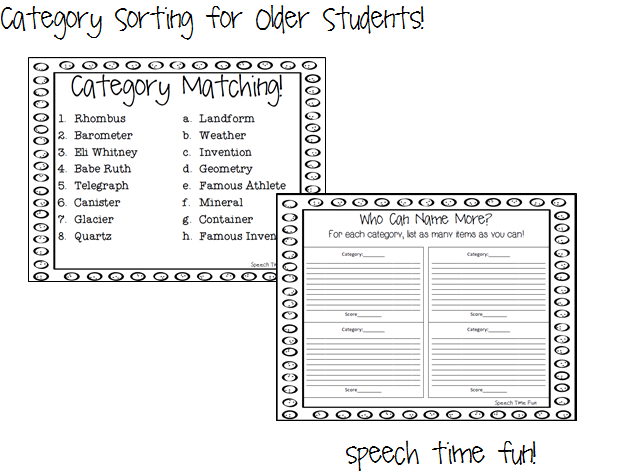
Category Sorting for Older Students!

Are you loving my packs for older students?  Well...I have created one more!! I have tons of students that are struggling to make connections with vocabulary words.  This impacts their ability to study for classroom tests (what vocabulary words go with that topic) and to make educated guesses on word meaning just by knowing what group it belongs into.  I created a quick sorting activity that incorporates age appropriate and academic vocabulary!
 How to use this activity/my suggestions?!

-Various sorting activities to build vocabulary for older students.

-Categories and words include: pop culture, academic vocabulary, and words to tap into background knowledge.

-Recommend having a computer with internet nearby!  If a student is unaware of a word or category, let them look it up on the internet to learn how to find it for themselves.  A reference page is provided with great websites for you to grab information for concepts your students struggle with or to direct them to find the answers!

-The various category mats and their cards are the same color borders to help easily grab and use.

-You can use this activity to help teach the “green group” bead for the Expanding Expression Tool (EET).


-Review worksheets are provided for extra practice, data collection, homework, and/or carryover.
You can access this pack in my TpT store by clicking HERE!

Wednesday, November 27, 2013

Should I or Shouldn’t I? What Would Others Think? (Product Review!)

I was fortunate enough to be provided with a copy of the game, “Should I or Shouldn’t I?” which is part of the Social Thinking products.  This game is designed to encourage social thinking and social problem solving.  I was provided with the middle and high school edition.  Since I don’t currently work with that population, I will explain this game for you and then explain how I plan on using it with the population I do work with (elementary students).

Who would benefit from this activity?
Students in a social skills group and working on understanding others perspectives and working on problem solving skills would benefit tremendously with this activity.  But you can also use with articulation and fluency students as well!  This is a great activity to get students talking!! 

What does this game come with?

  • Instructions
  • Prompt Card Desk with 100 cards
  • Challenge Card Deck with 50 cards
  • 6 sets of Voting Cards (numbers 1-5 in each set)
  • 6 copies of the “Should I or Shouldn’t I?” Behavior Scale

Ages & Players
Game questions, events, and scenarios are geared toward middle/high school students, ages 12-18.  But you can pull out cards that would work well with older elementary (I recommend higher cognitive levels). 
This game can be played with 1-6 players (therefore perfect for individual sessions as well as full speech groups).

What other materials would you need?
  • Paper & pencil/pen (to keep score) which you could also use a dry erase board or whatever board you have in your therapy room
  • Timer (any kind of timer, they suggested a visual timer if needed and if you have one)

Object of the game
Students will have to think about their own thoughts and behaviors as well as others during various situations they would encounter.  Match the other players’ responses to the situations described on the prompt cards to score points and win!  **Therefore, students who can comprehend what others would say will win!!  Creativity will not win this game, understanding others will!

Recommended preparation
Pull out all cards that your students may not comprehend or is too advanced. 
You may want to discuss the different situations or vocabulary ahead of time to make sure all students understand terms used in the activity.
Set up a scoring sheet with all students participating.
Shuffle the prompt cards and challenge cards together to form one deck of cards.

Explain or remind students about how to play and object of the game.
Review the behavior scale with students.  Review vocabulary and concepts to make sure students understand before starting the game.
Provide students with a model or practice round.  Show how you would read the card and then rate the behaviors using the options on the behavior scale.  
Have students agree or disagree with your choice and express why.  Now that you have modeled how to read a card, express an answer, use the behavior scale, and have other students agree/disagree and explain why, you are ready to play!!

Playing the game
  • Each player will select a set of color-coded voting cards and a behavior scale.  Students will hold the voting cards and they will keep the behavior scale on table in front of them.
  • Each player will take turns picking a card from the deck.
  • Students will read the prompt card.  The rest of the group will look at their behavior scale and come up with their response and pick a voting card to match their response.  They will place their voting card face down in front of them.  Once all the players have voted, they player that picked the card will call “flip” and all players will turn over their voting cards to share their responses and tell the group how he would rate the behavior according to the scale.  The players who voted in the majority will earn a point.  If there is no majority, no one will earn a point for that round.

**An example of a prompt card: “Someone in your social studies class is passing notes to another classmate.  You tell the teacher.”

  • If a player picks a challenge card, the player must attempt to answer the questions with a response that would be rated either a 1 or a 2 according to their behavior scale.  No other players can participate for this round.  The teacher/therapist/facilitator will determine if this response earns a point.


**An example of a challenge card: “How do you know if you have a crush on someone?”

  • Game is over when a player earns a certain amount of points, selected by you, or if time runs out and then points are tallied to determine a winner!


What is this behavior scale you keep talking about!?
This card/scale rates behaviors from 1-5 using a continuum.
1: Behaviors that make others have good thoughts.
2: Behaviors that are fine or okay.
3: Behaviors that make others have weird thoughts.
4: Behaviors that make others feel annoyed.
5: Behaviors that are against the rules.
Under each category, students are provided with further details and explanations to help them comprehend.


Things I like about this game/activity:
  • It provides a lot of opportunities for students to think about different social situations and what they would do. 
  • It allows for understanding what others would think/say/do.
  • It targets the older students which is a hard population to prepare for/find materials for.
  • It can be used with fluency and articulation students.  You can use this activity with younger fluency/articulation students as long as you pull the situation cards that are age-appropriate.
  • Motivating game with a way to earn points/have a winner.
  • Easy to adapt this game for your needs.
  • Tons of follow-up activities can be used after using this activity: discussions about which situations did they not understand, vocabulary building activities, role playing activities, and understanding how others think about each situation. 
  • You can even have students learn how different people would respond to different situations (teachers, principals, doctors, students, criminals, etc.)


**I definitely recommend this activity to those working with middle/high school students as well as those working on social skills.
**I hope they develop a similar version designed for younger students!!

Click HERE to learn more about this $22 product and click HERE to learn more about social thinking!

Saturday, November 9, 2013

My Fall Storytelling/Writing Guide! (PLUS A WRITING ROUND-UP)

It seems like many of you lately are enjoying my storytelling/writing guides.  I just realized I never created a fall one!!!  Well, I fixed that!!!

Have fun learning to create and creating a fun fall-themed story with all of the key story elements!!

Using this guide:
-Each page is a step in the writing/storytelling process
-Students can use suggested pictures or use their creativity to come up with their own

-Use method as a fun way to use theme vocabulary in an academic skill
-Teaches story elements

-Students can share stories and listen for story elements
You can access this activity in my TpT store by clicking HERE!

Check out my other storytelling/writing guides for other seasons/themes:

Looking for other writing activities?! Check out what else I have for you!

Thursday, November 7, 2013

Roll & Tell An Articulation Story!!

Looking for more articulation activities?? Running out of ideas on how to address these goals with older elementary/middle & high school students? Do you have articulation cases that also have language goals??  Are you forced to put articulation students in a group with students with only language goals!?! KEEP READING THIS IS FOR YOU!!!!!

Have fun working on articulation targets and telling funny stories at the same time!!

-For each articulation target, a visual is provided.

-Visual will contain: characters, setting, and problem.

-Students must roll the dice 3 times, one for each story element.  They can look on the visual to see which element choices they must include in their stories.  All elements will contain the target speech sound.

-A graphic organizer is provided for students to write down what they rolled.  They can use their imagination to complete the rest of the graphic organizer.

-A page is provided for students to write their stories and draw illustrations based on what they rolled.

-This activity is great for mixed groups with speech and language goals!!

-Target sounds included (in the initial and final positions):
/k, g, s, f, v, th, sh, ch, l, r, z/


****Suggestion: can have students express stories using the Story Grammar Marker.

You can access this articulation packet in my TpT store by clicking HERE!!

Sunday, November 3, 2013

Context Clues Detectives!

I have been working hard to teach my students how to use context clues the last few weeks.  I find the hardest part for my students is to figure out how they developed their answers!  I decided to create an activity to teach help teach them just that!

Using this activity:
-Cards are broken down into 4 different clue types.

-You can work on each clue one at a time or mix them all together and have students identify the type of clue given.

-Visuals are provided as the divider for each clue card section.

-You can use these cards with any motivating game or activity.

-The same graphic is used on the visual/clue type page and the cards that go with it to make it easier for you to grab and use.


-Review worksheets are provided.
You can access this activity in my TpT store by clicking HERE!