Showing posts with label product reviews. Show all posts

Thursday, September 11, 2014

Speech Page: Product Review!!

The generous and awesome folks over at Speech Page has provided me with 2 products to try out and review for all of you!  I decided go with a new theme, AAC!  I have many low functioning students, and I am working with them this year to use conversational scripts to expand utterance length for the purpose or requesting and interacting in activities.  I thought these would be PERFECT!!
What is the Speech Page? 
They are a speech materials company that sells ready to go laminated/Velcro-ed materials.  They come ready to go in a large zip lock bag.  Check out their website!


This fun activity comes with 4 themes/pages:  magic, snacks, toys, and food.  Students must request an action regarding one of the two images on the page.  They can use the visuals/AAC cards and hand them to the SLP to request an action or can use it to help elicit a verbal response.  The cute images and themes are so motivating!  My students loved asking to put things into the magic hat!
The pages have Velcro and even slits in the page so I was able to put the different images "into" the hat!

This activity comes ready to go for $20.99.

This activity comes ready to go with four pages/themes: school bus, fishbowl, snowballs/sled, rabbit/carrot.  Do you sense a 4 seasons use?! Um, I DO!  Students can use the visuals/AAC cards to hand to SLP to request or use to elicit verbal responses to help put the puzzle pieces together.  What do they need?  Can they ask?  Can they guess what the puzzles will be?  You can use this as a reinforcer for another game/activity as well!
I felt for this activity, sentence strips were helpful to elicit "I want the ____."  This activity comes ready to go with all pieces cut and Velcro-ed for $26.97.

These activities are great for lower functioning students.  I do feel that sentence strips are helpful to help promote expanded utterances.  You also have to teach your students how to use the visuals/cards to request.  You also must make sure your students are motivated by these activities in order to be motivated to request!  

Sunday, February 9, 2014

Speech Page Product Review!

A while back I reviewed some products from the company, Speech Page.  You can access it HERE.  I was honored when they contacted me again to review more products for you!  Remember the thoughts and opinions are all mine!


This activity pack comes laminated on a binder clip.  Great for easy use, storage, and long term safe keeping.  What does it include?  8 pages with 9 images on each!  What's on each page?
  • snowman
  • pizza
  • flower
  • fish tank
  • fruit bowl
  • cow
  • robot
  • Easter eggs

On the top of each page are directions for the students: "Listen carefully.  Tell me the ____ I am describing."

What are the students listening for?  This pack comes with a "feature and variable chart prompts and samples page."  It helps guide you to meet the goals!!  It breaks down prompts per picture page:
  • feature: "hat color" "open banana"
  • variables: yes/no, colors, tall/short, numbers
  • sample prompts (but you can create dozens more in addition to those provided): "show me the snowman that..." "...has a green hat" "...has 3 buttons, a green hat, and a red scarf"

These detail descriptions can be as simple or complex as you like!  Great for individualization and can modify for the different needs in a group.

Other ideas for use:
  • Can have students make own pictures with descriptions you say and try to match it to an image on the page.  Who can be the closest?
  • Compare/contrast
  • Work on describing concepts (can even use with the EET!)
  • Working on auditory memory
This great product is only $18.97!


This pack comes laminated and in a large Zip lock bag.  Great for safe keeping and storage.  

What is included?  5 pages which have 4 sequences of 4 pictures on each!  The pictures are on each page with Velcro.  Under each picture is a # 1-4 representing the sequence.  Pictures are color coded to make it easy to keep them together and for students to easily see how they go to together.  The pictures are seasonal (carving a pumpkin) and generic (pouring juice).  They are all mixed together on each page, but you can easily mix and match them to your liking.  Want all the food picture sequences on one page?  Just move them to do so!!  You can also have your students pick out from a pile of all of the pictures all of the food pictures and then determine which ones go together!

Directions are included on the top of each page for the students: "Put the pictures in the proper order at the bottom.  Tell me what is happening in each."  I love how the directions prompt receptive and expressive tasks!

This $22.49 activity comes with 20 sequencing pictures total!  The graphics are cute but covers so many concepts seen in children's worlds!

Last but not least, this activity comes also laminated and in a large Zip lock bag.  I love how they think about what SLPs like in terms of storage and safe keeping!  We love this stuff!!  In the Zip lock contains 6 pages.  On each is a chart with pictures: 3 nouns, 6 verbs, 3 nouns.  On the bottom of each page is a noun-verb-noun visual for how to create a simple sentence.  Students can take the picture cards from the chart, place them into the visual, create a sentence and then express it using appropriate verb tenses.
There is a reminder on each page: "No 'ed' endings!  What if it happened yesterday? right now? tomorrow?"  I love the reminders for no -ed!!  I also love the prompts for past, present, and future tenses!  All of the verbs included are irregular past tense verbs in their present tense form.  They all need to be changed to make all the verb tenses.

How do I plan on using this activity?  
  • I can give each student a page and they can mix and match pictures to make sentences.  We can work on one verb tense at a time while learning or I can make it interesting and pick a card with each (past, present, future) to prompt them to use that one each time!
  • You can put all pictures from all 6 pages in the middle.  Can students sort the subjects, verbs, objects?
  • Competition to create the silliest sentence!  Students can even illustrate their silly sentences on construction paper!
  • What's wrong?  Have students receptively make sentences, then you can express it using the wrong verb tense (like adding -ed!).  Can they identify if you are right or wrong!?
This great activity pack is only $15.97.

I love how Speech Page thinks of SLPs and makes activities interactive, easy storage, and easily adaptive to needs of our students.  I look forward to  using these products with my students and learning more about their other great products!!

Wednesday, November 27, 2013

Should I or Shouldn’t I? What Would Others Think? (Product Review!)

I was fortunate enough to be provided with a copy of the game, “Should I or Shouldn’t I?” which is part of the Social Thinking products.  This game is designed to encourage social thinking and social problem solving.  I was provided with the middle and high school edition.  Since I don’t currently work with that population, I will explain this game for you and then explain how I plan on using it with the population I do work with (elementary students).

Who would benefit from this activity?
Students in a social skills group and working on understanding others perspectives and working on problem solving skills would benefit tremendously with this activity.  But you can also use with articulation and fluency students as well!  This is a great activity to get students talking!! 

What does this game come with?

  • Instructions
  • Prompt Card Desk with 100 cards
  • Challenge Card Deck with 50 cards
  • 6 sets of Voting Cards (numbers 1-5 in each set)
  • 6 copies of the “Should I or Shouldn’t I?” Behavior Scale

Ages & Players
Game questions, events, and scenarios are geared toward middle/high school students, ages 12-18.  But you can pull out cards that would work well with older elementary (I recommend higher cognitive levels). 
This game can be played with 1-6 players (therefore perfect for individual sessions as well as full speech groups).

What other materials would you need?
  • Paper & pencil/pen (to keep score) which you could also use a dry erase board or whatever board you have in your therapy room
  • Timer (any kind of timer, they suggested a visual timer if needed and if you have one)

Object of the game
Students will have to think about their own thoughts and behaviors as well as others during various situations they would encounter.  Match the other players’ responses to the situations described on the prompt cards to score points and win!  **Therefore, students who can comprehend what others would say will win!!  Creativity will not win this game, understanding others will!

Recommended preparation
Pull out all cards that your students may not comprehend or is too advanced. 
You may want to discuss the different situations or vocabulary ahead of time to make sure all students understand terms used in the activity.
Set up a scoring sheet with all students participating.
Shuffle the prompt cards and challenge cards together to form one deck of cards.

Explain or remind students about how to play and object of the game.
Review the behavior scale with students.  Review vocabulary and concepts to make sure students understand before starting the game.
Provide students with a model or practice round.  Show how you would read the card and then rate the behaviors using the options on the behavior scale.  
Have students agree or disagree with your choice and express why.  Now that you have modeled how to read a card, express an answer, use the behavior scale, and have other students agree/disagree and explain why, you are ready to play!!

Playing the game
  • Each player will select a set of color-coded voting cards and a behavior scale.  Students will hold the voting cards and they will keep the behavior scale on table in front of them.
  • Each player will take turns picking a card from the deck.
  • Students will read the prompt card.  The rest of the group will look at their behavior scale and come up with their response and pick a voting card to match their response.  They will place their voting card face down in front of them.  Once all the players have voted, they player that picked the card will call “flip” and all players will turn over their voting cards to share their responses and tell the group how he would rate the behavior according to the scale.  The players who voted in the majority will earn a point.  If there is no majority, no one will earn a point for that round.

**An example of a prompt card: “Someone in your social studies class is passing notes to another classmate.  You tell the teacher.”

  • If a player picks a challenge card, the player must attempt to answer the questions with a response that would be rated either a 1 or a 2 according to their behavior scale.  No other players can participate for this round.  The teacher/therapist/facilitator will determine if this response earns a point.


**An example of a challenge card: “How do you know if you have a crush on someone?”

  • Game is over when a player earns a certain amount of points, selected by you, or if time runs out and then points are tallied to determine a winner!


What is this behavior scale you keep talking about!?
This card/scale rates behaviors from 1-5 using a continuum.
1: Behaviors that make others have good thoughts.
2: Behaviors that are fine or okay.
3: Behaviors that make others have weird thoughts.
4: Behaviors that make others feel annoyed.
5: Behaviors that are against the rules.
Under each category, students are provided with further details and explanations to help them comprehend.


Things I like about this game/activity:
  • It provides a lot of opportunities for students to think about different social situations and what they would do. 
  • It allows for understanding what others would think/say/do.
  • It targets the older students which is a hard population to prepare for/find materials for.
  • It can be used with fluency and articulation students.  You can use this activity with younger fluency/articulation students as long as you pull the situation cards that are age-appropriate.
  • Motivating game with a way to earn points/have a winner.
  • Easy to adapt this game for your needs.
  • Tons of follow-up activities can be used after using this activity: discussions about which situations did they not understand, vocabulary building activities, role playing activities, and understanding how others think about each situation. 
  • You can even have students learn how different people would respond to different situations (teachers, principals, doctors, students, criminals, etc.)


**I definitely recommend this activity to those working with middle/high school students as well as those working on social skills.
**I hope they develop a similar version designed for younger students!!

Click HERE to learn more about this $22 product and click HERE to learn more about social thinking!

Wednesday, August 28, 2013

Silly Sets!! ((product review & giveaway!))

I was recently contacted by Kim Patterson, an SLP that created a fun product for Super Duper Inc.  She provided me with a copy of it to check out and review for all of you!  She also promised another copy for one lucky winner on my blog!!  How amazing!!  First off, I love it when fellow SLPs do amazing things and getting a product published is a huge accomplishment!


Silly Sets: Minimal Pairs for Maximum Progress

This card deck comes in a cute, small box which is easy for storage.  There are 100 cards!!  The cards are color coded to make it easy to find what you need.  The cards are sorted by phonological processes.  On each card are fun sentences and cartoons containing minimal pairs.

On one side is a cartoon/comic.  
On the other side are sentences with minimal pairs:


How can you use this?
  • Auditory bombardment of target sounds/processes
  • Listening skills: can your students hear their sounds and discriminate between those sounds and its minimal pair?
  • Tons of opportunity to practice.  These cards will elicit conversation which will incorporate the target sounds/processes!
  • Great for showing students how when the sound is altered, it can change the meaning of the message.
  • Great way to laugh!!  These are just so cute and funny!  It is humor your students will understand!!
  • You can easily pair these cards with a fun & motivating board game or activity.
  • Have your students come up with their own comic strips!  Great way to add creativity to this activity!
Four different phonological processes targeted: 
  • Final Consonant Deletion
  • Cluster Reduction
  • Fronting
  • Stopping
Learn more about this $21.95 product by visiting Super Duper's website by clicking HERE!

Does this card deck look like something your students would benefit from?!  Now you can enter to win a free set for yourself!!! Enter to win below!

a Rafflecopter giveaway

Wednesday, August 14, 2013

Speedy Speech! A Quick Artic Program ((product review))

With RTI and the rise of classroom teachers understanding they can ask SLPs to provide interventions, the need for a quick way to provide more interventions to more students has grown.  If you are like me, you may be hesitant to stray away from the 30-45 minute sessions.  There has been several authors/companies that are creating materials for an intensive program in a smaller amount of time.  This will allow SLPs to get lots of data, make better use of less time, and get to see more students.  

I was fortunate to be provided with a copy of the Speedy Speech School Edition Program (/r/ and /s/).  Note, the opinions are all mine!  Keep reading to learn more!


The Speedy Speech program was created by JoAnn Tuttle & Tamara Truax, an SLP & TSHH.  Each book contains an entire program for treating that particular phoneme in all positions and clusters.  This program was designed to help students correct speech errors quickly and efficiently in short 5-10 minutes one-on-one drill sessions.  By utilizing the SLPs expertise and this programs multi-sensory approach, this program uses a hierarchical model (auditory bombardment and discrimination, then word, phrase, and sentence level drills with co-articulation practice).

There are 8 stages of this program.  Students are expected to receive a mastery level of 90% in order to move onto the next stage:

  • Sound in isolation
  • Sound in syllables and consonant-vowel combinations
  • Sound in the initial position of one and two syllable words
  • Sound in the final position of one and two syllable words
  • Sound in the medial position of one and two syllable words
  • Sound in phrases
  • Sound in sentences
  • Sound in conversational speech
In each book, the following program materials are provided to make your life easier and provide you with the ability to implement the program:
  • Program guide
  • auditory bombardment in words
  • auditory discrimination pair sets
  • sound bridge
  • drill words, phrases, and sentences

  • conversational prompts
  • record forms

  • homework calendars
  • parent and teacher letters
motivational charts and certificates


Things I like about these books/program:
  • Very comprehensive.  Has all of the letters, charts, forms, and materials you would need in one book.  
  • Doesn't take up that much space.  Tons of artic cards and materials can clutter an already small speech room.  This program is small and easy to store.  
  • Love the use of the hierarchy to target each phoneme.  They provide materials for each stage which makes it easy to treat at any level.
  • They provide step-by-step what you need to be successful.  
  • Tons of suggestions for using the program in a school setting.  They understand the challenges and needs of a school SLP.
  • Detailed description of each component of the program.  No need to guess how this program should work.
  • Great for RTI data/approach
My other opinions/thoughts:
  • This program will work best if you have a student with only one or few articulation errors.  May not work well with those with oral motor issues and phonological processes.
  • Administrators/teachers may not be open with change.  They may not want you to take students for that short of time, may be too distracting to the classroom.
  • 5-10 minutes may not be enough time to work on phonemic placement.  This may work best for students in the carryover phase or are stimulable to those sounds.
  • However, this program may help determine which students will require a more intensive, pull-out approach and those that can benefit from these "quick drills" aka who needs to receive a full, comprehensive speech-language evaluation/IEP.
Want to learn more about this program?!!  Click the following links to learn more!

Thursday, July 18, 2013

Miss Speechie's Top 10 Favorite Games to use in Therapy!

Are you looking to add new games into your therapy rooms?!  Are you wondering how I use common, open-ended games?!  Keep reading!!

Below, is my top 10 list of games I love to use in my speech room!  I tried picking different games then I have featured in previous posts!!

10.  Connect Four: I love to use this game!  I use it when I work individually with students (student vs. myself) or when there are groups of two.  Students must drill or answer a question and then can take a turn.  It helps work on social skills and problem solving skills while practicing speech/language skills!


9. I Spy Go Fish Card Game: This game is great for those with little storage space or traveling SLPs.  It is exactly as it sounds, a card game!  But each card has pictures to be found!  Students must play "go fish" and ask for one of the items in each picture.  Can they guess the main picture in each card to ask the correct question?  I use this game to work on fluency, articulation, asking questions, social skills, and so much more!

8. Perfection:  Are your students competitive?  Are you looking for ways to bring in more competition into your speech rooms?!  Have students take turns competing in this game as a reward for working hard on their speech sounds!  Who can get the most pieces in before time runs out?
7. Honey Bee Tree: This game is just like the game Kerplunk but it is more child friendly and easier to use for those with OT difficulties.  After students answer questions or practice their various skills/strategies, they can take turns taking out leaves.  Who will make less bees drop?  Your students will be requesting to play this game over and over!

6. Simon:  Do you remember this game from YEARS back?!  It is a great way to work on following directions and memory skills.  It is also just fun!  Students must watch the colors light up and remember then in order to press the buttons in the correct order to imitate!  Can also work on prepositional and sequential concepts!

5. Cat In The Hat: I Can Do That Game!: Have fun practicing Dr. Seuss vocabulary while following multi-step directions!  The props are fun and engaging!  The cards provide tasks for students to complete with the props.  You can change the way the game is played based on the levels of your students.  There are up to three task cards students can pick for each turn such as "take four giant steps" and "with a cake" and "on your head."  Perfect for SLPs!!!
4. BopIt:  This is probably the most requested game in my therapy room!  Students must practice their "whole body listening" strategies such as ignoring background noise and no talking while another student is listening.  They must listen and follow the directions quickly and accurately.  We like to use the "pass it" mode where students are also given directions to pass it around to the next student.  It is a great way to reward students at the end of a session if free time while still working on auditory memory/comprehension strategies!
3. Zingo: This game is just like BINGO using common objects.  Practice matching, labeling, turn taking, prepositions, answering questions, and other social skills with this game.  The dispenser is just motivating in itself!

2. Crocodile Dentist:  Do you remember this game from a while back?  Who doesn't love alligators/crocodiles?  This game teaches cause/effect, turn taking, dentist vocabulary, prepositions, and is a great way to reward students for working on their skills!  Students must pull out a tooth without the crocodile closing it's mouth on them! Ah!
1. Stare Junior: This game is great for working on memory, visualization, answering questions, and higher level thinking.  It is great for working with older students.  You can even use this game with articulation/fluency students when working on carryover into the conversational level.  Students must "stare" at a picture (cute and motivating) until a timer runs out.  Then they must roll a dice to get a variety of question types that requires them to recall details in that picture.  LOVE THIS GAME!!!

What games would be on your list?  Have you tried any of these games?  Which ones are your favorites?  I would love to hear from you!

Disclaimer: This post contains affiliate links.

Tuesday, July 2, 2013

Whole Body Listening Larry Books! ((product review!!))

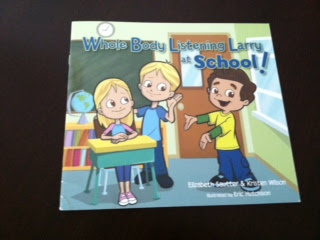
A colleague of mine in the past introduced me to the concept of "whole body listening."  She knew of someone that went to a workshop where it was discussed and she incorporated the concepts into her speech room.  Since that day (many moons ago) I always begin my school year by introducing my students to "whole body listening."  Using Boardmaker and other crafty resources, I made some visuals but I have been eyeing the Whole Body Listening Larry books which is part of the Social Thinking Products by Michelle Garcia Winner.  Both books were written by Kristen Wilson and Elizabeth Sautter.  I was THRILLED when they offered to send me their two books to check out and review for you.  I am SO excited to bring these in and begin the school year by reading them to my students!  Keep reading to learn more!  


Whole Body Listening Larry at School


This book is a great way to introduce the concept.  It teaches students that it is important to use the entire body in order to listen.  It uses cute cartoons/comics to teach as well.  It gives examples of the wrong ways which helps illustrate the concept.  The book teaches this concept with the characters Leah and Luka, twins that are new to a class/school.  The teacher tells the class to help them learn the rules.  Throughout the book, Larry helps the twins realize that their behaviors will impact their abilities to listen and points it out to them.   The book goes through the various settings at a school: recess, classroom, rug for book time, music room, on a field trip, etc. 
What else does the book have?  It has a handout that can be photocopied and sent home or reviewed after the book is read.
The book also has a sheet with a "craft" activity.  You can photocopy but I recommend using a color copy machine.  You can use this to make your own visual or reinforce the concepts learned with your students.  You can have your students glue the various pieces into their speech notebooks and write down next to each piece what they need to do and why.  But guess what, this page is also available on their website!! Click HERE to get your own copy of this page!!!
The book has a variety of follow-up activities in it which are FABULOUS! I am so excited to use them!  Would never have thought of some of them!

What else can you address with this book?
  • Character traits
  • Wh- questions ("Who is not listening?" "Where are they now?" "Why should you listen to the teacher?")
  • Key story elements: characters, setting, problem, solution
  • Social skills: What would you say to the twins?  How should you listen during conversations and why?
  • Sort right way vs. wrong way of behaviors and make a chart on board/chart paper

Want to teach kids how to carryover their new listening skills at home?  Are parents requesting ideas to help work with their children?  This is the book!!
This book is about Larry and his family at home.  Sister Lucy does not know how to listen with her whole body.  Larry points out all of the times she is not listening appropriately and teaches her the right way!  

This book also uses a cute cartoon/comic to teach!  Students and parents will love this one!
This book also has suggestions to parents on how to reinforce the whole body listening strategy at home.
This book also has the coloring/craft page and handout for you to photocopy and use.

Again, this book can address other skills:
  • Answering questions
  • Role playing/social skills
  • Character traits
  • Summarizing
  • Parent involvement
  • Repetition
  • and more!
These books are great!  I am so excited to use them in my therapy room!!!    It will make a HUGE difference in the way I introduce the concept in September!  Do you use whole body listening?  Have these books?  How about the poster? I recommend this book in your "wishlist" as you plan for the upcoming school year!

Saturday, June 22, 2013

Thinking About You Thinking About Me ((product review!!))

I was provided with the opportunity to review “Thinking about YOU Thinking about ME” book by Michelle Garcia Winner.  This book teaches perspective taking and Social Thinking to persons with Social Cognitive Learning Challenge. 


This book contains 11 chapters which are all designed around the different aspects and steps towards teaching social thinking and perspective talking.  The chapters include:
-Perspective Talking: Thinking, Learning, and Teaching
-The keys to perspective talking
-The four steps to communication (an overview and the breakdown of each step)
-Social behavior mapping
- The me binder: teaching students about their IEPs
-About the Social Thinking Dynamic Assessment Protocol
-Standardized Assessments: comments and critiques
-and an entire appendix filled with forms and materials related to the Social Thinking Dynamic Assessment Protocol

I am not going to lie; to go through this entire book will take the entire summer!  But I have flipped through it to the parts that caught my eye and I know you will want to know about most!  This book is a great reference tool for those teaching perspective talking and other social thinking skills.  There are tons of charts and forms for teachings, school psychologists, SLPs, TAs and more!  No need to create your own! 


Some aspects that caught my eye and will be extremely helpful next year with my students:
-The various charts provided that compare typical and impaired students in the areas of perspective talking.  These charts will be useful in the RTI/evaluation process and justifying services.
-The different game activities that can be photocopied such as the “thinking about you vs. just me” activity. 
-Handouts that can be photocopied and used with older students such as one to teach students about creating files in their brains to remember facts about others.  This is great to teach students that it is important to know information about others not just yourself.  This will help them know how to initiate and maintain conversations.
-Questions used to engage others in social interaction.  This is a great visual for you to prompt or your students to prompt themselves.
-Conversation Tree concept:  take one topic and create branches or subtopics of conversation based on the base of the tree.  Trees can keep on growing with many branches and so can conversations.  LOVE this idea!
-Conversation Street concept/vocabulary:  Similar idea to the tree but instead of one base and growing into branches, a street can change, turn, stop and go just like a conversation.  I LOVE this idea as well!!  Any way to teach pairing with a symbol makes it easy to each, use, carryover and practice.  Can you picture the drawings your students can make with this idea?!
-Worksheets/charts that relate to the “I’m A Social Detective” book such as the excepted and unexpected behaviors based on contexts.
-Prompts to elicit conversations, story scenarios to read to your students, and activity suggestions for a variety of activities for each aspect of social thinking and perspective talking.
-Teaching students about their own IEPs.  There are worksheets for them to fill out such as their own strengths/weaknesses, about their therapists/TAs/teachers, and goals.  This helps students learn to be advocates for themselves and understand what they need to work on.   This will also help you create IEPs with students’ input.
-Questionnaires for teachers and other professionals working with the students.  This will help maintain constant communication with other team members.  This will help you address needs in the classroom in your therapy rooms.  This will help with progress monitoring, identification/data collection for RTI, and keep lines of communication open.  We, as SLPs in the schools don’t always see the same behaviors/issues as teachers in a large classroom with other students/distractions.


Things I like about this book:
-Great resource for SLPs & those working with students with social skills goals
-Tons of handouts, activities, and resources to be used to teach social thinking and perspective talking
-Love the suggestions on how to introduce and teach the various concepts
-Great charts, questionnaires, and handouts that will be helpful with the RTI and IEP writing process
-Great reference material when trying to find ways to teach and break down the various skills necessary


I definitely recommend this book and other reference materials related to Social Thinking by Michelle Garcia Winner.  This 316 page book costs $48.  Have you been to any of her workshops?  What materials do you use and recommend??

Thursday, June 20, 2013

You are a social detective! ((product review!))

I recently received a copy of “You are a Social Detective!” by Michelle Garcia Winner & Pamela Crooke.  This is a great book for explaining social thinking to kids.  Not familiar with social thinking?  Learn more about it by clicking HERE!!  This book is part of the Social Thinking program which I highly recommend to all those working with students with social skills goals.


This book is a comic book!  How motivating!  This adorable detective cartoon will teach your students all they need to know about social skills!  You can use it over and over again with your students to review their social skills.  There are three different sections: school smarts/social smarts & expected behavior, unexpected behavior, and being a social detective.  It is best to use this book combined with real life discussions and role playing activities!


This book refers to “social smarts.”  This teaches students that you are always thinking about others and others are thinking about us.  You use these smarts whenever you are around people.  How great of a concept to teach our students?!


This book also talks about expected and unexpected behaviors.  What do you expect people to do socially in school, on the playground, and in conversations?  The behaviors that you cannot predict or expect others to do is called unexpected!  Examples:  child not doing what their parents tell them, not paying attention to a teacher, and saying mean words.  This book teaches students that these unexpected behaviors can make others feel uncomfortable. 

It teaches students that it is important to know what is expected and that each different place/situation can have different expectations!  Being a social detective means that you are using your social smarts (aka all of these learned skills!).   If students use clues from all around them and run them through their brains (think about it), students then can figure out how to behave in all different places. 


The book asks students questions to elicit conversation about what they've learned in the book! 


What else does the book include? 
-A list of new vocabulary words and definitions discussed in the book about social detectives and social smarts
-Notes to parents about carryover and where they can find more resources
-3 social lessons to use in conjunction with this book!

My suggestions for carryover activities:
-Role play expected and unexpected social scenarios
-Sort pictures and sentences which depict expected and unexpected social behaviors
-Sort expected social behaviors into different locations: school, home, stores, etc.
-Students can make their own social detectives comic strip using what they've learned!

-Practice being detectives!  Give students clues and they must determine what others are thinking, going to say, and expected to do!  For example:  A student is in class and sitting at their desk in the back of the room.  The teacher is writing on the board the homework.  How is the student expected to do, look, say, and feel?

Want to more learn about this book? Visit their website to learn how you can access this $20 book by clicking HERE!