Showing posts with label Reading. Show all posts

Saturday, June 21, 2014

100 Minutes Book Study Chapter 8 - Small Group Learning

Thinking of Teaching


One of the books that I am reading this summer for a book study is 100 Minutes by Lisa Donohue. If you missed my previous posts you can find them below:

Chapter 1
Chapter 2
Chapter 3
Chapter 4
Chapter 5
Chapter 6
Chapter 7

Today I am linking up with Emily from Emmy Mac's Class for Chapter 8.  She is also hosting a giveaway for a $10 TpT gift card and a $20 shopping spree in her store, so make sure you head over there to enter!


My thoughts on Chapter 8:

I always notice the most growth in students during small group instruction, so I was excited to read Lisa Donohue's take on it as well.  She states that small group instruction is the vehicle for teachers to be able to monitor individual students and to provide them with differentiated instruction based on their needs.  She also says that it can be a time for students to set and monitor their goals.  I have previously only done this in individual conferences, but I think that using small group time to do this will not only be more efficient, but will also give students the opportunity to observe their peers setting goals as well.  I could see having a small group comprised of two strong goal setters with two weaker goal setters just for that purpose.

Grouping Students

Lisa also gives a variety of ways in which to group students including:

1. Personal interest (non-fiction interests such as snakes, fiction interest in a certain author or series).
2. Student's current areas of strength and need.  (fluency, comprehension, decoding, etc.)
3. Instructional levels

The most important thing about grouping students is that they should not be "forever" groups.  She states that groups should change on average, once a month.

Small Group Reading Lessons

A typical small group lesson should last 15-20 minutes. Donohue says, "Ensure that students are spending the majority of the time reading the text."  That is so easy to forget as we want to get in there and teach.  She says the teacher should:

1. Set the stage for reading
2. Engage students in discussion during reading
3. Allowing students to reflect after reading

Writing Conferences

I have had individual writing conferences with students, and I have had students work in groups to discuss their writing, I have even had whole group writing conferences, but I have never had actual small group writing conferences.  Last year my students were really successful when they worked together in small groups to review their writing.  I had blogged about these sessions in previous posts:

                    Roll and Retell

                    Increasing the Level of Student's Writing


However, I often felt like I didn't get enough opportunity to coach them when there were issues (a student not participating in the group, or when they all couldn't think of anything more to share or add to the conversation) or to assess who needed more help as I flitted from group to group.  I LOVE the idea of having small group writing conferences together and then giving them the opportunity to work on peer editing themselves later.  I can't thank Lisa Donohue enough for giving me this format to grow my practice.  I love this gradual release of responsibility model and I can't wait to try it out this year.  I really see how it will add to my students' learning.

Feedback  

Donohue says that feedback is most helpful when it is "descriptive and skill-based".  She says feedback that is evaluative in nature, such as , "This is level 3 work" can give students an indication as to what they are successful at and what they need to work on.  We use Marzano's scales, so this could be easily incorporated.

She also says that the teacher might refer to mentor texts as well as the success criteria to model ways that the criteria is used for the student.

Donohue cautions that a writing conference is not a time when students hand over their work to the teacher in order to have it corrected (I am so guilty of that!). She says it is not the teacher's job to fix the mistakes, but instead is to draw the writer's attention to areas of confusion and areas that need improvement by posing questions in a way that cause the author to revise and rework the piece.

I love this because I know that often times I become frustrated when the same student makes the same mistakes over and over again. Donohue states that the reason for this is because the student is not an active part of the process when the corrections are being made.  They must be involved in order to actively learn and transfer that understanding to a new situation.


  • I would like to create or find an interest sheet that I could use to group students into small reading groups throughout the year.  I really like this idea and it would make natural book clubs rather than just by ability alone.

  • This chapter has really had me evaluating my small group instruction.  I am thinking about changing what I have been doing (which is mostly leveled readers and text book work) to have articles or short stories the students can read. When they initially come to group, I will have them read the assigned reading silently while I make sure the rest of the class has begun their work independently.  I will then introduce the skill we are working on and then have them choral read to certain sections. During the reading I will pose questions based on the specific skill we are working on.  After reading the students will reflect and respond. (I know that sounds like a jumbled mess right now, but as I develop it into actual lessons I will share!).


I want to think more about how to make feedback more visible to the student.  What do they specifically need to do to move their work from a level 2 to a level 3?


Next up- Chapter 9: Building In New Literacies
Be sure to visit our co-host Tina from Croft's Classroom on June 25th to continue this learning journey with us. 


Wednesday, May 28, 2014

Tips For Reading To Kids | Reading Comprehension Stories

While reading to youngsters a day could be a well-known rule for mothers, any parent for that matter, to follow, many of us do not know a way to set about this. this is often very true for brand new mothers. as an example, you'll not grasp whether or not you must amendment your voice as you scan a story, if you would like to form your kid sit through the whole story, after you ought to answer your child's queries, etc. you'll assume that there's not a wrong thanks to scan to youngsters, and you are right, however there ar many things that you simply will do to form the expertise higher for them. Below ar many tips you'll realize useful. purpose to Words: a part of reading to your youngsters is orientating them with the word. to assist do that, after you scan to your youngsters you must drag your finger below the words as you scan them. Not solely can this draw your children's attention to the words on the page, however it'll conjointly teach them a way to scan correctly…from right to left.
Tips For Reading To Kids | Reading Comprehension Stories


Utilize Nursery Rhymes: There ar a spread of books out there that target Nursery Rhymes. you must use these actually because they're short stories that contain assonant words in a very repetitive manner. this is often necessary as a result of once youngsters ar exposed to an equivalent words over and over, particularly at intervals an equivalent story, they start to instantly acknowledge those words.

Tips For Reading To Kids | Reading Comprehension Stories


Variety: scan your youngsters a spread of various books. do not simply scan one specific book over and yet again, night when night, instead switch it up. you may scan a Bible story one night and a Thomas the Train story consequent. after you do not target one specific variety of book, you may be inculcation a love for all totally different varieties of books in your youngsters. As your youngsters age, add non-fiction books into the combination still. Even magazine articles ar sensible to scan still.

Be Interesting: To instill a love for reading in your youngsters, you would like to form the stories attention-grabbing. In most cases, all this needs is that you simply have a decent angle concerning reading to your youngsters. However, ever-changing your voice from character to character can facilitate too. the most factor that creates a story attention-grabbing for kids is after you have a decent angle and rejoice at story time.

Attention Span: several first-time oldsters hold high expectations for his or her toddlers. it is vital to recollect to form reading fun still as instructional. Therefore, you would like to require your child's span into thought. If you would like to scan a complete story, then you must decide short books to scan to your kid. Have patience as a result of over time, his span will increase and then with the length of the stories you're able to read to him.

Question and Answer: it is vital to require the time to answer your children's queries they need a couple of story throughout your reading time. whether or not you stop mid-story or not is up to you. For toddlers with short attention spans, it might be higher to answer queries when every page, except for older youngsters waiting till when the story is finished is also best. you would like to assist your children's reading comprehension skills develop and respondent your children's queries can do this. additionally, it's sensible at the tip of the story to raise your youngsters queries still. this may conjointly facilitate their reading comprehension and memory skills.

Monday, May 12, 2014

Ungifted - Must Read Monday


We just started a new read aloud and it is hilarious!  I picked this book up at our Scholastic Book Fair and I am so glad that I did.  It tells the story of a trouble-making boy who causes trouble at this middle school.  One of his antics goes just a little too far, and he is sure that he is going to end up in reform school or worse.  Instead, due to an administrator's mix-up he is sent to a school for gifted kids, which he is sure that he is not one of.  

My kids were laughing out loud as I read the book.  I have to wait for the laughter to subside to continue reading, but it is so worth it, because this is just one of those books that MAKES kids WANT to read!  

With all of my read alouds I have the students write down reactions as we are reading.  Before this read aloud I asked them to share at least one thing they are gifted at.  I got some really thought provoking responses.  Some were exactly what I expected, but others really took me by surprise.  I love how this book roots for the underdog and I can't wait to finish it with them!

I am linking up with Teaching Maddeness for Must Read Monday - Head over there for some other great book suggestions!
Must-Read Monday Linky


If you haven't entered already, be sure to head over here to win a $25 Teachers Pay Teachers Gift Card.  Only 1 day left!


Sunday, April 20, 2014

Must Read Mentor Text - How To Build Your Own Country


I am linking up with Collaboration Cuties for Must Read Mentor Texts.  This week we are focusing on Social Studies.

We have been reading How To Build Your Own Country.


The students have been loving to read how countries are formed as we are "creating" our own countries.  Some "countries" in my class include: Manland, Frozenia, and Shapetopia.  I will share our projects when we finish them up after Spring Break.  For now here are a few of the pages.


The book is written in small chunks that can be used individually for class read alouds, in small groups, or independently.  It has been one of the most engaging non-fiction texts I have found!


Friday, April 18, 2014

5 For Friday April 18, 2014


Happy Spring Break to me!  Officially 3 hours in and I am loving it!  Time to share the week with Doodle Bugs Teaching Five for Friday!

This post will be a lot more pics and a lot less text because...


I fell, crashed into my bedroom dresser.  Luckily just sprained.


Random gifts from my students like this one helped me feel better!


Today was our annual egg drop.  ALL of our eggs survived this year!


We also had "wood shop" class as we made reading chairs.


We still need to finish covers.  I will share pics when they are done.


http://media-cache-ec0.pinimg.com/736x/bd/db/8f/bddb8f5c2adca424b88846e47937f83b.jpg

And last but not least, I just wanted to let you know that many sellers are celebrating Easter with a sale at Teachers Pay Teachers!  I am offering 20% off on both April 20th and April 21st at my store..  

Monday, April 14, 2014

5 Things To Do With $1 Scholastic Book Selections


I don't know about you, but I am always excited to see the $1 selections each month in the Scholastic Book orders.  They are so affordable, and there are so many ways to use them in your classroom.  Here are a few ideas:

1. Book Raffles
Reward your students with raffle tickets when you catch them being good.  They can place their tickets into a container for the book of their choice.  You could also just place out one book each month and raffle that off instead.

2. Whole Class/ Small Groups
I love the idea of reading the same novel to give a common ground for discussion, but it can be quite spendy to shell out money for entire class sets.  $1 books are a great way to keep it affordable.  You might even request that your parents order the book for their student to read that month.

3. Birthday or Christmas Presents
Do you give out small gifts to your students for their birthday?  Why not hand out a book as their present.  At just $1 it is affordable to gift every student in your class with a book.  I teach at a Title I school, and many of my students don't have books at home.  This is a great way to get more books into their hands.

4. Partner Reading
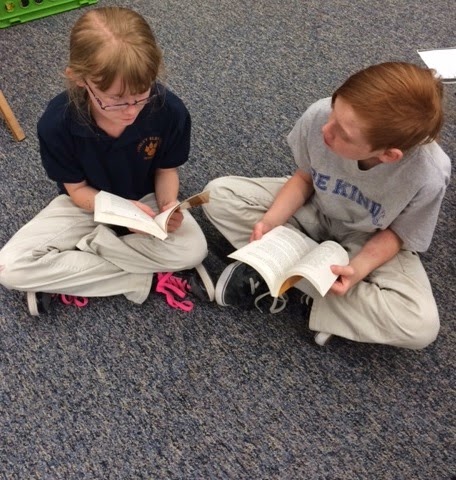
My students love Read to Partner during Daily 5.  Having each child have their own copy of a book makes it easier for older students to read together.

5. Incentives
Wondering what to give your students as an incentive or reward?  Why not use the $1 books in your class store, or just as a reward for reaching a goal of some sort?  I reward students who earn 25 AR points with lunch this year.  I am thinking about rewarding them with these $1 books next year instead.

What ways have you used Scholastic $1 Books in your classroom?