Showing posts with label problem solving. Show all posts

Tuesday, September 2, 2014

Problem Solving

No matter what grade I have taught (3rd, 4th, or 7th), it seems that one of my students' biggest challenges is problem solving!  In talking with other teachers I realize that I am not alone - problem solving can be challenging!


 I have been using problem solving math journals for a few years now and they have helped a ton! But, this year I wanted to kick it up a notch with even more problem solving practice.  Because in reality, we don't spend our adult lives solving problems on a worksheet, but instead have to engage in real world problems such as how much tile to order, balancing our checkbooks, modifying recipes, etc.  That is what our kids have to be successful with!

Here are a few of our math lessons this week:

We started our multiplication unit by reading this book:

Two of Everything is about a couple who find a magic brass pot that doubles everything that is put inside. My students LOVED this book and besides the math application to it, several wrote stories about what they would put in a magic pot like this and what might happen.  Love when you can hit multiple subjects at once.  We really talked about the idea of doubling being multiplying by 2.  I was often perplexed when my 4th graders last year (who had their math facts down cold) would get deer in the headlights looks when I asked them to double or half anything.  I am determined that my students this year won't have that same problem.

We then did a few practice problems together.

If I put 2 shoes in the pot, how many will come out?
If I put 4 dollars in the pot, how many will come out?
If I put 3 pencils in the pot, how many will come out?

Then I gave them worksheets with similar problems to solve.  I would love to say that they were all able to solve the problems independently (or even in partners).  I would love to show you pictures of them happily solving the problems, but I can't because that isn't what happened.  It was downright ugly and we had a few students in tears.  Had I already killed their love of math in 3rd grade????

Determined to remedy the situation, I regrouped and bought some chocolate.  Everything is better with chocolate right? Even multiplication?  I sure hoped so.

I posed the following problem to my students (after waving the bags of M&Ms as a bribe to think about this multiplication thing again).

Mrs. Malloy has 3 boys living at home.  She wants to give each of them three M&Ms.  How many does she need?

Then I passed out the M&Ms to let them try it.  Who needs stinking worksheets anyway?


Again we struggled a little bit, but this little smartie figured it out!  So, we fishbowled around her to let her explain her method.


As she explained, I could practically see light bulbs forming above their heads!  "I GET it now!"  They rushed back to their seats ready for the next problem.  I used the same problem as before, I just changed the numbers in them.


The sweet taste of success!  Made better with the sweet taste of M&Ms when they were done.

The next day we were ready to step it up a notch.  We were ready to model and use equations and sentences to explain our work.  Using the MESS acronym I use in my math journals.


This time I posed the problem that they were having a party and they needed to fill goody bags with 5 candies each.  How many candies would they need?  We rolled the dice to see how many people we were each inviting.  Then I gave them some plain construction paper and markers to show their thinking.  Here are a few examples:


We have been working on underlining words that we aren't sure how to spell (to mirror the underlining in Word) and I was happy to see this transfer to math!


This one was able to model the problem and solve it correctly, we just need to work on matching up our equations with the problem.


I love how this student signed her math problem Love, (her name)!  Too cute!


No tears this time!  Just problem solving perseverance! 

And even a little partner work..


I love when they spontaneously help each other out!


Wednesday, June 26, 2013

What's Your Math Problem!?! Book Study Chapter 3

I am linking up with
Jennifer Smith-Sloane from 4mulaFun


Meg Anderson  from Fourth Grade Studio


Jamie Riggs from MissMathDork


and Jennifer Findley from Teaching to Inspire 5th Grade

for this book study on What's Your Math Problem!?!


 If you missed my previous posts you can find them here:

Chapter 1
Chapter 2
                                         

Chapter 3 - Getting Started Strategies

This chapter focuses on four strategies:

  • Restate the problem in your own words
Before restating the problem, Gojak suggests teaching the students to read the problem three times.
  1. The first read is to provide a general familiarity with the information in the problem.
  2. The second read helps you to put the problem into your own terminology, focusing on the specifics of the problem.
  3. The third read helps you reduce the problem to only relevant ideas.
I'm not sure that I agree with this format exactly, but I do like the idea of having them read a problem multiple times.
  • Identify wanted, given, and needed information
Gojak emphasizes the need to model this strategy.  She recommends getting students in the habit of recording wanted, needed, and given information so that they will focus on theses areas.
  • Identify a subgoal
This strategy is for multi-step problems or problems where the student may not have all of the information readily available in the problem.  They may need to solve something or research something first.
  • Select appropriate notation
This strategy shows students how to show their thinking in solving a problem.

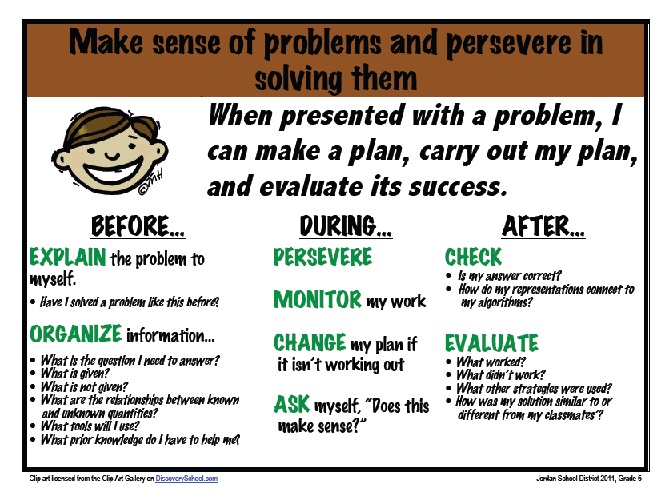
This chapter reminded me of a resource that I was given during our unit revision workshop.
 

Thursday, June 20, 2013

What's Your Math Problem!?! Book Study Chapter 2

I am linking up with
Jennifer Smith-Sloane from 4mulaFun


Meg Anderson  from Fourth Grade Studio


Jamie Riggs from MissMathDork


and Jennifer Findley from Teaching to Inspire 5th Grade

for this book study on What's Your Math Problem!?!


 If you missed my posting for Chapter 1 you can find that here.

Chapter 2 - Planning for Problem Solving in the Classroom

What Does it Mean to Plan for Problem Solving?

Students have difficulty solving problems in part because they do not have the necessary framework to approach these tasks.  They have been taught to compute and follow procedures. Solving problems involves much more than simply following procedures. In order to help students to learn to solve problems, you must plan for instruction that will help your students to become problem solvers.

Step 1: Finding a Good Problem - You need to find problems that both  involve the mathematical concepts that you are planning on teaching, but are also "doable" for your students. The author suggests building a library of rich problems.


 4mula for Fun has this freebie form to help you plan.  Visit her site to access it as well as to see an example of how she would use it in her classroom.

Step 2: Provide Your Students With A Problem Solving Framework

Gojak recommends using George Polya's 4 principles of problem solving:

1. Understand the Problem
2. Devise a Plan
3. Carry out the Plan
4. Look Back

Gojak continues on to describe a new model of problem solving called the Launch, Explore and Summarize Instructional Model.

The Launch stage engages the students in the problem they are about to solve.
 
 
The next stage, Explore, is where the students work as a class, in small groups, with a partner, or individually to solve the problem. 
 
The final stage, Summarize, is the area that I most overlook, and yet it is where the main teaching should occur according to Gojak. 
 
My main takeaways from this chapter:
 
1. I definitely need to plan my math lessons differently.
 
2. Gojak provides some question stems at the end of this chapter that I need to incorporate into my lessons.  Jennifer at 4mula for fun mentioned printing them out and putting them on a ring to use throughout the lesson, and I definitely think that is something I am going to do as well.
 

Wednesday, June 19, 2013

What's Your Math Problem!?! Book Study Chapter 1


I am linking up with
Jennifer Smith-Sloane from 4mulaFun

Meg Anderson  from Fourth Grade Studio

Jamie Riggs from MissMathDork

and Jennifer Findley from Teaching to Inspire 5th Grade

for this book study on What's Your Math Problem!?!


I missed posting for Chapter 1 last week, so this post will include  my thoughts on Chapter 1 and I will post my thoughts for Chapter 2 tomorrow - then I should be back on track.

Chapter 1 - The 5 Ws and and H of Problem Solving

Gojak opens the book with a quote from Van de Walle, "Problem solving develops the belief in students that they are capable of doing mathematics and that mathematics makes sense."  I agree - it does seem that half the battle is getting past the mental blocks that students have put up against math.

What is Problem Solving?

She then discusses what problem solving is and what it isn't.  What you and I might have come to know as problem solving (think word problems at the end of a lesson in a textbook) are actually routine problems.  The kind that we really don't have to think about.  They match the lesson, so we already know what formula we are using, we just have to plug in some numbers.

Real problem solving is what we deal with in real life.  The type where we have to go beyond the procedure, the type where students do not immediately know what equation to plug the numbers into. 

Why teach Problem Solving?

Not only does the National Council of Mathematics recognize that problem solving should be "an integral part of all mathematics learning.." but, problem solving is everywhere.  We do it each and every day in almost every career.  If we want our students to be college and career ready, they need to be problem solvers.

Who should solve problems?

Short answer - EVERYONE!

When should we solve problems?

According to Gojak, problem solving should be a part of every mathematics class. EVERY?  I definitely need to work on this next year.  Did you include problem solving in every class?

How should we teach problem solving?
The author suggests beginning lessons with rich problems as a context to help students understand the context behind the mathematics for that day's lessons.

Where can you find good problems?

The million dollar question right?  A variety of resources were given including problem solving books, and websites such as Illuminations and PBS Mathline.

My main takeaway from this chapter - I need to incorporate a lot more problem solving in my lessons! 

Wednesday, December 5, 2012

Problem of The Day


Every day I put a problem of the day on the board for my kiddos to solve.  I usually use real world problems and examples using either the students or my family.  My fifth grader noticed that I did this the other day, and asked why?  I told him that my students are always curious about my family, so they enjoy these little problems. 

Today I had collaboration in the morning and my kids usually hang out in my classroom before school.  When I came back in, I noticed this on the board.  My fifth grader had written a problem of the day for the students!  While it was a little too challenging for my third graders - I thought it was a great way to stretch my 5th grader.  I think I might have him come up with problems more often!

It also made me think that it might be fun to ask some of my students to come up with problems as well.

Do you incorporate problem solving into your daily lesson? What things do you do?